Release notes for MediaCoder 0.8.22 (Stanley posted on May 22nd, 2013 )

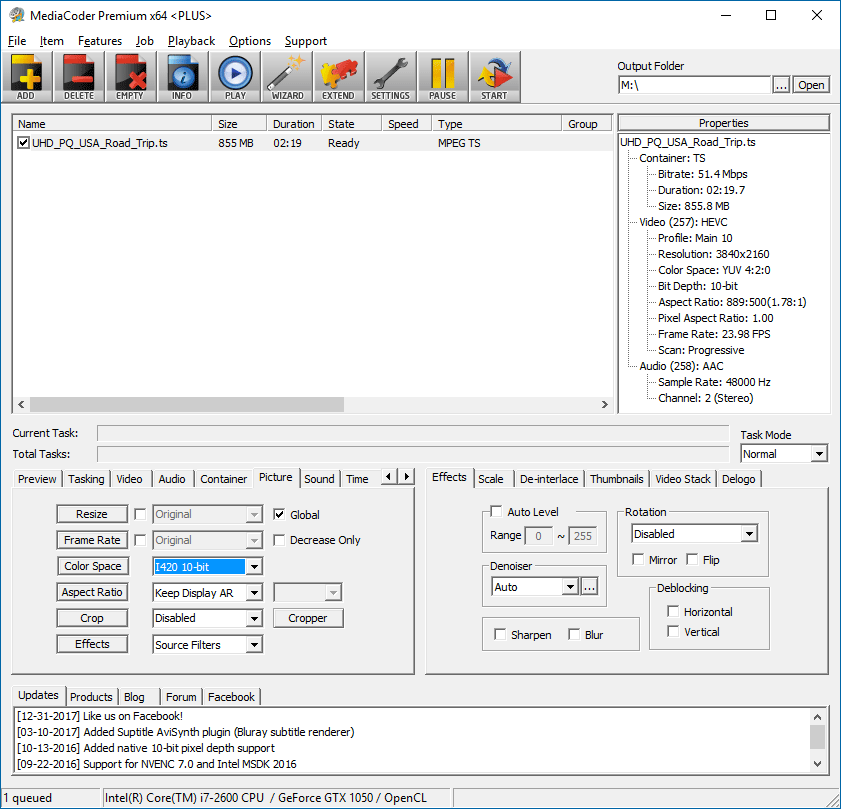
I am so excited to release this new version as a new exciting technology named Segmental Video Encoding (SVE) was introduced in after a long time of thinking and implementation. The idea of SVE is straight-forward. On systems with a lot of processor cores or processors, a single instance of video encoding cannot utilize all the computation power of the systems, though modern encoders like x264 already has good support for multi-threading. This also happens when doing GPU-based encoding, whereas the GPU is quite often under-loaded. SVE is basically the mechansim of encoding of a video in temporal segmentations, by loading 1~2 minutes video frames into memory and dispatch the frames to multiple encoder instances. A series of encoded video segments will be generated and they are concatenated seamlessly in the muxing stage together with the audio. This improves paralellization regardless of the encoder’s support for multi-threading, so those encoders without good multi-threading implementation (Xvidcore, MPEG 1/2 encoder etc.) will benefit. Please be noted that SVE is still experimental. If you experience problem with it, please report to me in the forum. I also need some more testings on cutting-edge computer systems which I don’t have a chance to test on.

mc_segmental

MediaCoder working with Segmental Video Encoding technology

Read the rest of this entry >>

Segmental Video Encoding is coming! (Stanley posted on May 18th, 2013 )

Can’t take out all the computation power of your multi-processor system when doing transcoding? A new technology being developed in MediaCoder will be the solution. I name it SVE (Segmental Video Encoding). It is like multi-segments downloading, but the difference is the segmentation is temporal instead of spatial. Multiple instances of the same encoder are used to encode the different part of one video concurrently. The result bitstreams are merged by muxer together with audio. My practice has proved that this is completely feasible, without almost no compromise. This will increase overall transcoding speed on all under-loaded systems (a system with many CPUs or processor cores) reglardless of the encoder’s multi-threading capability, as well as GPU encoding (in most cases GPU is under-loaded when encoding a single stream). My test has shown a 20% speed boost of Intel MSDK GPU encoding on the same Intel i7-2600 system. Distributive encoding will also benefit from this technology. So stay tuned!

AudioCoder 0.8.21 released (Stanley posted on May 15th, 2013 )

A new release of AudioCoder is just out. In this release, several bugs have been fixed, related with audio CD ripping and cuesheet file parsing. Opus audio codec gets updated to 1.1. QAAC is adopted to replace QTAAC which has not been updated for quite a while. An option tab was also added for QAAC. If you want to encode with QAAC (actually with Apple’s CoreAAC engine), you need to install iTunes or QuickTime. If you don’t want to install them, you may also grab a package of DLLs from here (see README inside).
Read the rest of this entry >>

Resolution auto adjustment improved (Stanley posted on May 14th, 2013 )

Resolution auto adjustment is just improved in 0.8.21.5395 to make display aspect ratio conversion more easily without specifiying a target resolution. With these settings, the height of output resolution will be automatically calculated according to specified display aspect ratio and whether to crop or expand the frame.
Read the rest of this entry >>

Release notes for MediaCoder 0.8.21 (Stanley posted on May 6th, 2013 )

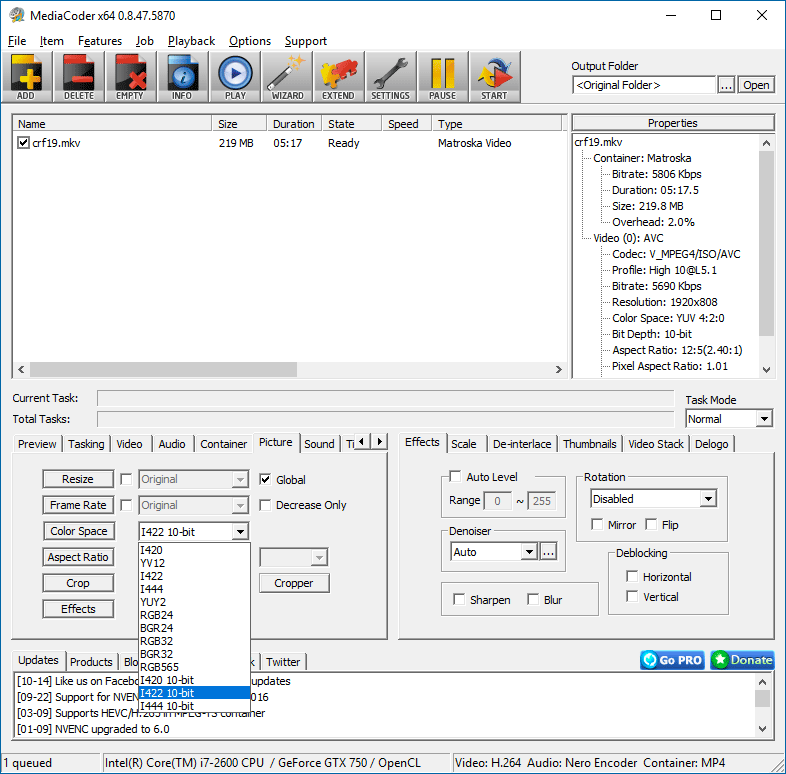
In this release, one major change is that the distribution includes two versions of x264 one of which is OpenCL enabled. An additional option of “Enable OpenCL” has been added when clicking x264 tab’s Advanced button. When this option is ticked and OpenCL runtime is detected on your system (you will see “OpenCL” on the status bar), MediaCoder will use the OpenCL enabled version of x264.

MediaCoder with x264 OpenCLThe newly added x264 OpenCL option

Read the rest of this entry >>

H.265 in MediaCoder? (Stanley posted on April 19th, 2013 )

I think this is going to happen as H.264/HEVC seems getting high these days, especially after a Chinese online video giant xunlei.com annoucing their adoption of H.265 in their kankan video streaming service. After some lookups, I found following implementations of HEVC encoder.

I will start evaluating all of these and see what can be done to add H.265 encoding in MediaCoder.

Release notes for MediaCoder 0.8.20 (Stanley posted on March 30th, 2013 )

In this release, several major components used in MediaCoder get updated, including MPlayer, MEncoder, FFmpeg and MediaInfo. MPlayer and MEncoder have not been updated for a while. The latest SVN build seems to be a bit faster and the long broken Blu-ray reading seems get fixed in the SVN trunk, so that I dare to sync the binaries in MediaCoder to the latest code after some basic tests. Hopefully nothing else is going to be broken in MPlayer and MEncoder. If you think there is, please inform me ASAP (by emailing me or posting a bug report on the forum) cause I am always a little bit scared when performing an upgrade for them.

Besides, several bugs have been fixed. Please refer to the changelog for more details.

Release notes for MediaCoder 0.8.19 (Stanley posted on March 10th, 2013 )

This is basically a maintenance release. Some minor issues got fixed, including decoding of RMVB video (in MKV container) going out-of-sync issue. The parameters for the temporal denoiser (which is default on since recent builds) is fine tuned a bit. x264 is updated to revision 2273 and FFmpeg is updated to version 1.1.3. You may also notice that the appearance of program icon is improved with more high resolutions versions and it just looks better on Windows 8.

MediaCoder GPU encoding quality improved practically (Stanley posted on January 17th, 2013 )

An approach for improving GPU encoding quality has been done in 0.8.18.5450. A high quality and high performance temporal denoiser is implemented and automatically activated when encoding with GPU. This will not improve SSIM but the pre-processing will make up for the shortage of all GPU encoders (Intel MSDK and CUDA) and improve perceptual visual quality of the encoded content. As the denoiser is working fully parallel to decoding and encoding, there is very little performance overhead.

With this improvement, GPU encoding quality is now generally acceptable, especially for playback on mobile screens, and more specifically, 1.5Mbps video encoded by CUDA encoder looks quite good on iPhone screen.

TAGS:

64-bit CUDA encoding breakage in build 5338 fixed (Stanley posted on December 31st, 2012 )

I am careless recently. Things are fixed in build 5342.

Happy new year!

TAGS:,