I was counting the years since the beginning and it is 17, including 3 quite different ones from the previous. When last blog post was written, the world was such a different one. Anyway, since I am still here, I feel it’s time to give MediaCoder a refresh. A new release will be out soon with some good performance boost. Stay tuned!
Category Archive: News & Updates
MediaCoder with GPU decoding and AMD GPU encoding (Stanley posted on November 9th, 2019 )
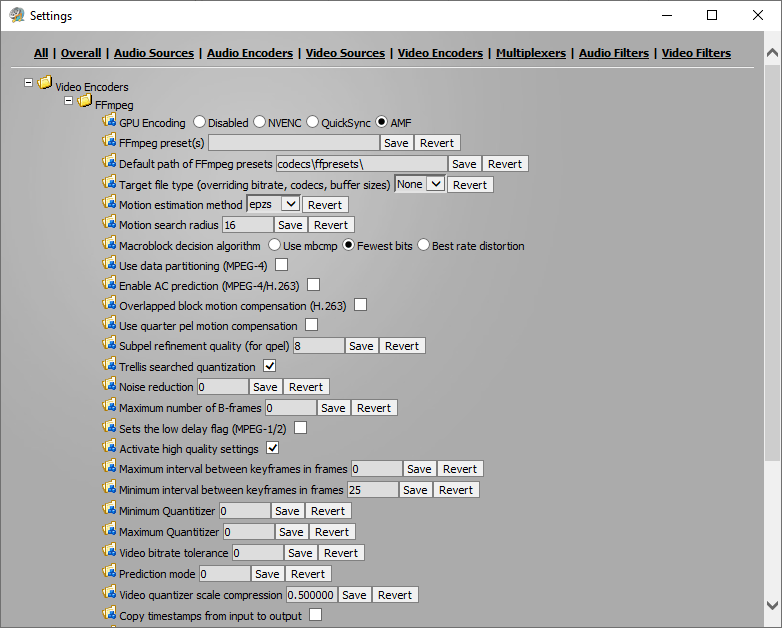
MediaCoder 0.8.59 has been released, with support for hardware accelerated decoding and AMD’s AMF accelerated encoding, both via FFmpeg. Being nearly 15 years old, MediaCoder is still having a solid user base which is so amazing to me whenever I realize this. I won’t give any imprudent promise of great new features, but I will definitely keep improving it and enjoying from doing so.
To enable GPU decoding, tick the GPU check box by the Video Source option. To use AMF for encoding, it’s slightly more inconvenient, as AMF auto detection is not yet implemented. Set Video Encoder to FFmpeg, click the Video Encoder button to call out advanced settings and change GPU Encoding option to AMF.
MediaCoder 0.8.55 released (Stanley posted on September 5th, 2018 )
MediaCoder is always getting better. Before the GUI is completely re-written as an Electron app, a new minor update release is out. Since 64-bit system is already dominating for a while and the fact that more and more encoders are optimized for 64-bit systems, soon we will no longer maintain and release the 32-bit version of MediaCoder. Probably this is the last 32-bit release. Farewell, x86!
Happy new year and keep encoding! (Stanley posted on December 30th, 2017 )
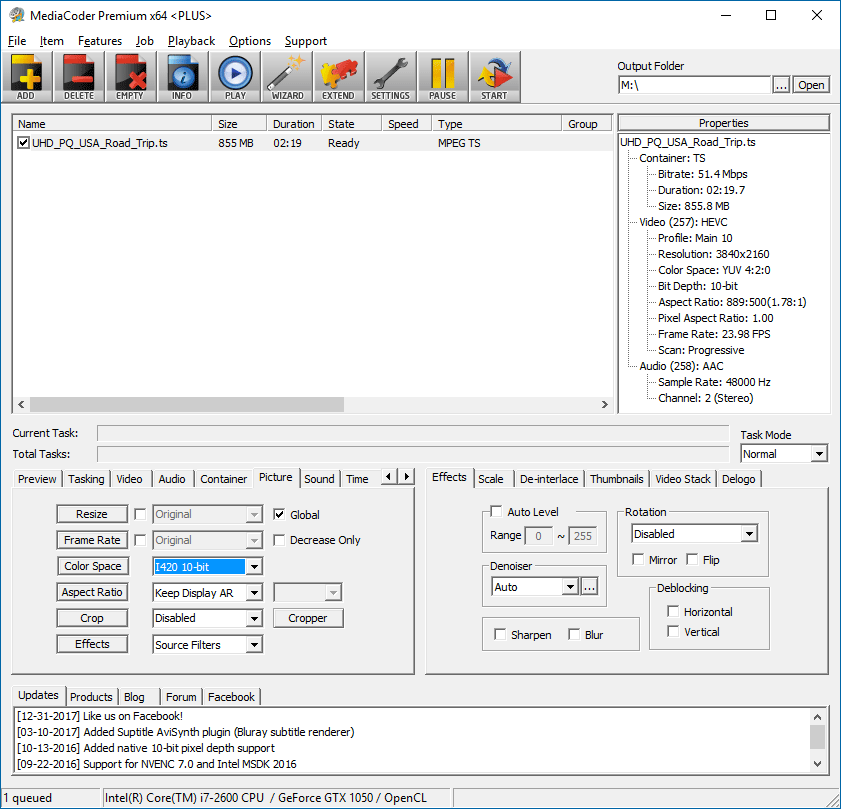
For all the encoding nuts, MediaCoder has you covered. Latest version 0.8.52 has improved 10-bit color depth encoding. If you happen to have some 10bpp video contents and a powerful box, you can do some insanely highly quality 10bpp HEVC transcoding with x265 and NVENC (requires Geforce GTX 10XX). Just change “Color Space” option from default I420 to I420 10-bit or I444 10-bit and you are ready to go.
The year 2018 is coming very soon. It will be the 13th year since MediaCoder was born in 2005. Time flies and it is still getting better! Let’s all keep up in the new year.
MediaCoder now with native 10-bit pixel depth support (Stanley posted on October 14th, 2016 )
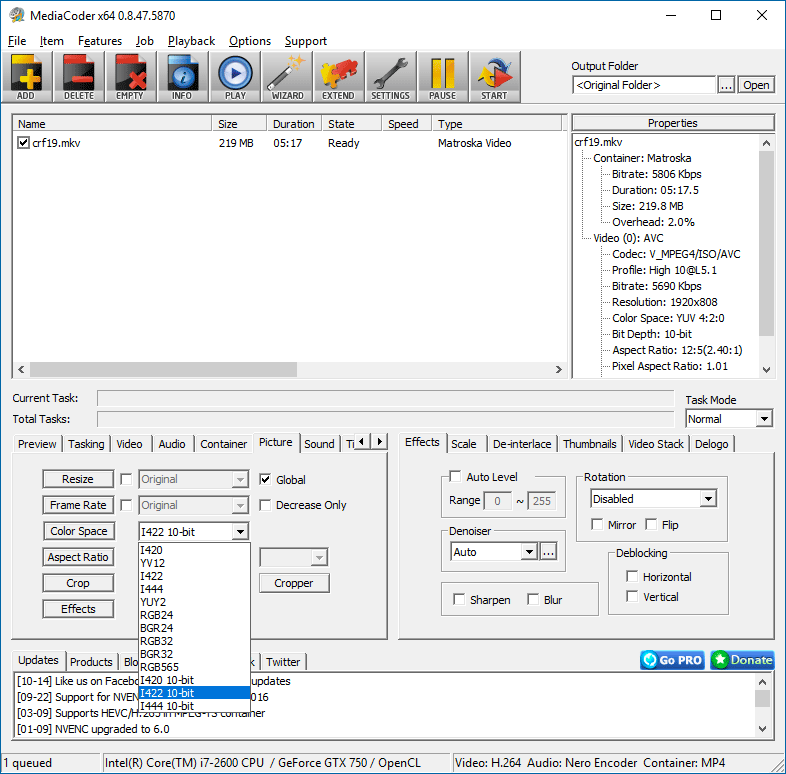
MediaCoder 0.8.47 comes with native 10-bit pixel depth support. 3 color space options were added:
- I420 10-bit,
- I422 10-bit
- I444 10-bit
Formerly in MediaCoder, 10bpp video content are down scaled to 8bpp for processing. The native 10-bit pixel depth support is ideal for transcoding 10bpp content to 10bpp output. Currently only x264 and NVENC support 10bpp input. When encoding 10bpp H.264, make sure to choose correct profile on x264 tab.
MediaCoder updated with NVENC 7.0 and Intel MSDK 2016 (Stanley posted on September 24th, 2016 )
MediaCoder 0.8.46 is released, with support for NVENC 7.0 and Intel MSDK 2016. Try some ultrafast H.264 and HEVC encoding with your cutting-edge GPU! Make sure to update your graphic driver to latest.